Why Choose Content Summarization for Learning Success


Every American student faces a flood of information in today’s digital classroom. With educational YouTube content growing by over 60% in recent years, finding meaningful summaries can be the difference between confusion and clarity. Whether you’re deep into research or just getting started at university, learning to condense complex material into focused insights can elevate your study routine and help you grasp essential concepts faster.
Table of Contents
- Content Summarization: Definition And Principles
- Types Of Content Summarization For Video Learning
- How SummYT AI Summarization Technology Works
- Key Benefits For Students And Researchers
- Common Challenges And Mistakes To Avoid
Key Takeaways
| Point | Details |
|---|---|
| Effective Summarization Techniques | Utilize extractive, abstractive, and hybrid methods to condense information while preserving key messages and insights. |
| Evaluation Metrics | Assess the quality of summaries through metrics like compression ratio, semantic preservation, and readability. |
| Practical Use for Students | Leverage summarization technologies to enhance learning efficiency and retention of complex materials. |
| Common Challenges | Address semantic drift and information loss by cross-referencing summaries with original sources to ensure accuracy. |
Content summarization: definition and principles
Content summarization represents a strategic approach to distilling complex information into concise, meaningful representations while preserving essential insights. At its core, summarization involves transforming extensive source material into a more compact form that captures the fundamental message, key arguments, and critical details. Advanced summarization techniques distinguish between multiple methodological approaches, including extractive, abstractive, and hybrid models, each with unique strategies for condensing information.
The primary principles of effective content summarization center on maintaining semantic relevance, information density, and coherence. Extractive methods identify and extract the most significant sentences or segments from the original text, while abstractive techniques generate entirely new sentences that capture the source material’s essence. Researchers have developed sophisticated algorithms that analyze linguistic patterns, semantic relationships, and contextual significance to create summaries that are not merely shorter versions of the original content, but intelligent, context-aware representations.
Several critical evaluation metrics guide the quality of content summarization. These include compression ratio (how much the original content is reduced), semantic preservation (how accurately the summary represents the source material), readability, and information coverage. Academic research has demonstrated that successful summarization goes beyond simple text reduction, requiring nuanced understanding of language, context, and the underlying conceptual framework of the source material.
Pro tip: Practice multi-stage summarization by first creating a rough draft summary, then progressively refine it, focusing on eliminating redundant information while maintaining the core message and critical insights.
Types of content summarization for video learning
Video learning content summarization encompasses several sophisticated techniques designed to transform lengthy multimedia content into concise, meaningful representations. Advanced video summarization approaches primarily categorize these methods into three fundamental types: extractive, abstractive, and hybrid summarization strategies, each offering unique mechanisms for condensing educational video content.
Extractive summarization represents the most straightforward approach, where key segments or frames are directly selected from the original video to create a representative summary. These methods typically employ algorithmic techniques to identify and extract the most significant moments, such as sections with high information density, critical explanations, or visually distinct sequences. Keyframe extraction and shot-based summarization are common extractive techniques that help learners quickly grasp the essential content without watching the entire video.
Abstractive summarization, in contrast, employs advanced machine learning models to generate entirely new textual or visual representations that capture the video’s core message. These sophisticated algorithms analyze linguistic patterns, semantic relationships, and contextual nuances to create summaries that are not mere excerpts but intelligent, synthesized representations of the original content. Comprehensive video summarization techniques demonstrate that hybrid approaches combining extractive and abstractive methods often yield the most comprehensive and informative summaries, particularly in complex educational contexts.
Pro tip: Always cross-reference video summaries with original content to validate comprehension and identify any potential semantic gaps or nuanced details that automated summarization might have missed.
Here’s a quick comparison of summarization techniques used for video learning:
| Summarization Type | Key Mechanism | Ideal Use Case | Limitation |
|---|---|---|---|
| Extractive | Selects key frames or segments | Fast highlights for long videos | May omit subtle context |
| Abstractive | Generates new descriptive content | Explaining complex topics | Requires advanced AI models |
| Hybrid | Combines extractive and abstractive methods | In-depth learning overviews | Potential processing complexity |
How SummYT AI summarization technology works
SummYT’s AI summarization technology leverages advanced machine learning algorithms to transform video content into concise, meaningful summaries. The platform utilizes sophisticated natural language processing and computer vision techniques to analyze and extract the most critical information from educational and professional video content. Understanding AI summarization technologies involves recognizing the complex interplay between semantic analysis, content recognition, and intelligent compression.

The core technological framework operates through multiple sophisticated stages. Initially, the AI performs deep semantic analysis, breaking down the video’s audio and visual components into discrete informational units. Advanced neural networks identify key concepts, track contextual relationships, and evaluate the relative importance of different segments. This process involves sophisticated machine learning models that have been trained on extensive datasets across multiple domains, enabling the system to understand nuanced content across academic, professional, and educational contexts.
The summarization process integrates several cutting-edge techniques, including natural language generation, machine learning classification, and intelligent content compression. The AI assesses linguistic patterns, speaker emphasis, visual content density, and semantic significance to generate summaries that capture not just the literal content, but the underlying conceptual framework. By combining extractive and abstractive summarization approaches, SummYT’s technology can produce summaries that are both precise and contextually rich, providing users with highly targeted, information-dense representations of complex video content.
Pro tip: Optimize your AI summarization experience by providing clear, high-quality source videos with distinct audio and minimal background noise to enhance the accuracy of automated summary generation.
Key benefits for students and researchers
Content summarization technologies offer transformative advantages for students and researchers navigating complex information landscapes. Advanced information processing techniques enable learners to efficiently extract critical insights from extensive academic materials, dramatically reducing time spent on research and comprehension tasks. By distilling complex content into targeted, digestible formats, these technologies provide unprecedented opportunities for accelerated learning and knowledge acquisition.
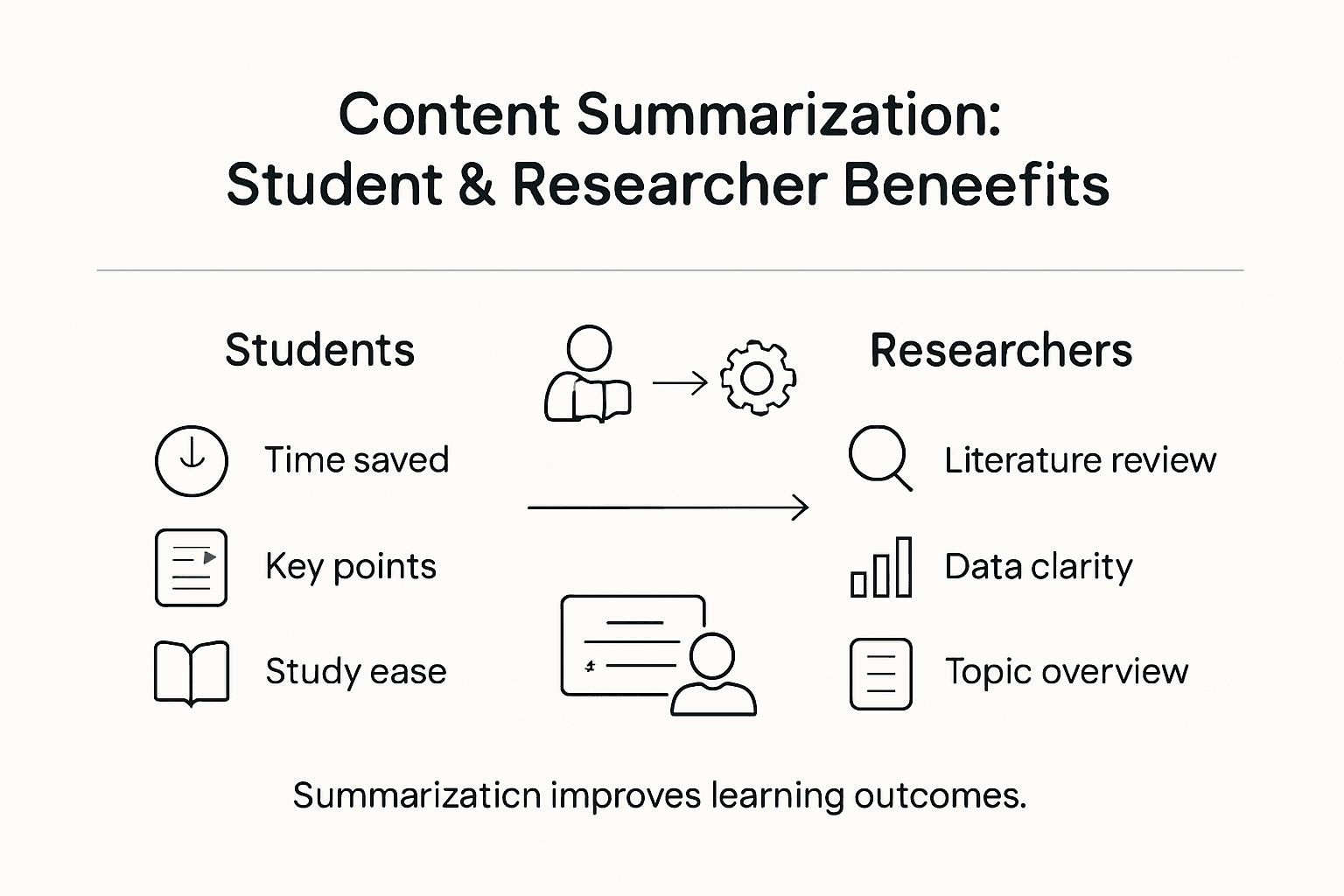
For academic researchers, content summarization represents a powerful tool for comprehensive literature reviews and interdisciplinary exploration. The technology allows scholars to quickly scan and synthesize large volumes of research publications, journal articles, and multimedia educational resources. Advanced algorithms can identify key themes, methodological approaches, and critical findings across multiple sources, enabling researchers to develop more nuanced, comprehensive understanding of their field without becoming overwhelmed by excessive detail.
Students benefit significantly from content summarization through enhanced learning efficiency and improved information retention. The technology supports multiple learning styles by providing condensed, focused representations of complex educational content. By breaking down intricate concepts into clear, structured summaries, students can more effectively grasp challenging subject matter, review critical information before examinations, and develop stronger critical thinking skills. These summaries serve as powerful supplemental learning tools that complement traditional educational resources and support independent, self-directed learning strategies.
Pro tip: Always cross-reference automated summaries with original sources to ensure comprehensive understanding and validate the accuracy of extracted insights.
Common challenges and mistakes to avoid
Content summarization technologies present complex challenges that users must carefully navigate to maintain information integrity and learning effectiveness. Advanced summarization research reveals critical pitfalls that can significantly compromise the quality of automated summaries, highlighting the need for strategic approach and critical evaluation.
One primary challenge involves semantic drift and information loss during the summarization process. Automated systems can inadvertently distort critical context, omit nuanced details, or misrepresent the original content’s core message. Researchers and students must remain vigilant, recognizing that algorithmic summaries are tools to supplement, not replace, comprehensive understanding. Critical evaluation involves cross-referencing summaries with original sources, identifying potential misinterpretations, and maintaining a skeptical approach to automatically generated content.
Several fundamental mistakes can undermine the effectiveness of content summarization. Common summarization errors include over-reliance on automated technologies, failing to verify extracted information, and neglecting to maintain proper citations or attribution. Users frequently make the error of treating summaries as definitive representations rather than condensed insights. This can lead to superficial comprehension, misinterpretation of complex concepts, and potential academic integrity issues when used without proper critical analysis.
Pro tip: Develop a systematic verification process by comparing automated summaries against multiple sources, focusing on identifying potential discrepancies, contextual nuances, and critical information that might have been inadvertently omitted during the summarization process.
The table below outlines major challenges and recommended solutions for content summarization:
| Challenge | Impact | Recommended Solution |
|---|---|---|
| Semantic drift | Misinterpreted summaries | Cross-reference with original content |
| Information loss | Missing key details | Review summaries for gaps |
| Over-reliance on automation | Superficial understanding | Verify with manual checks |
Unlock Learning Success with AI-Powered Content Summarization
The challenge of navigating dense educational videos and lengthy lectures without losing critical insights is real. This article highlights common pain points like semantic drift, information loss, and the need for both extractive and abstractive summarization techniques to maintain clarity and context. If your goal is to save time while capturing the essential knowledge quickly and accurately SummYT offers a powerful solution tailored to your needs. Our AI-driven platform transforms complex YouTube videos into clear concise summaries that preserve meaning and insight so you can focus on learning without the overload.
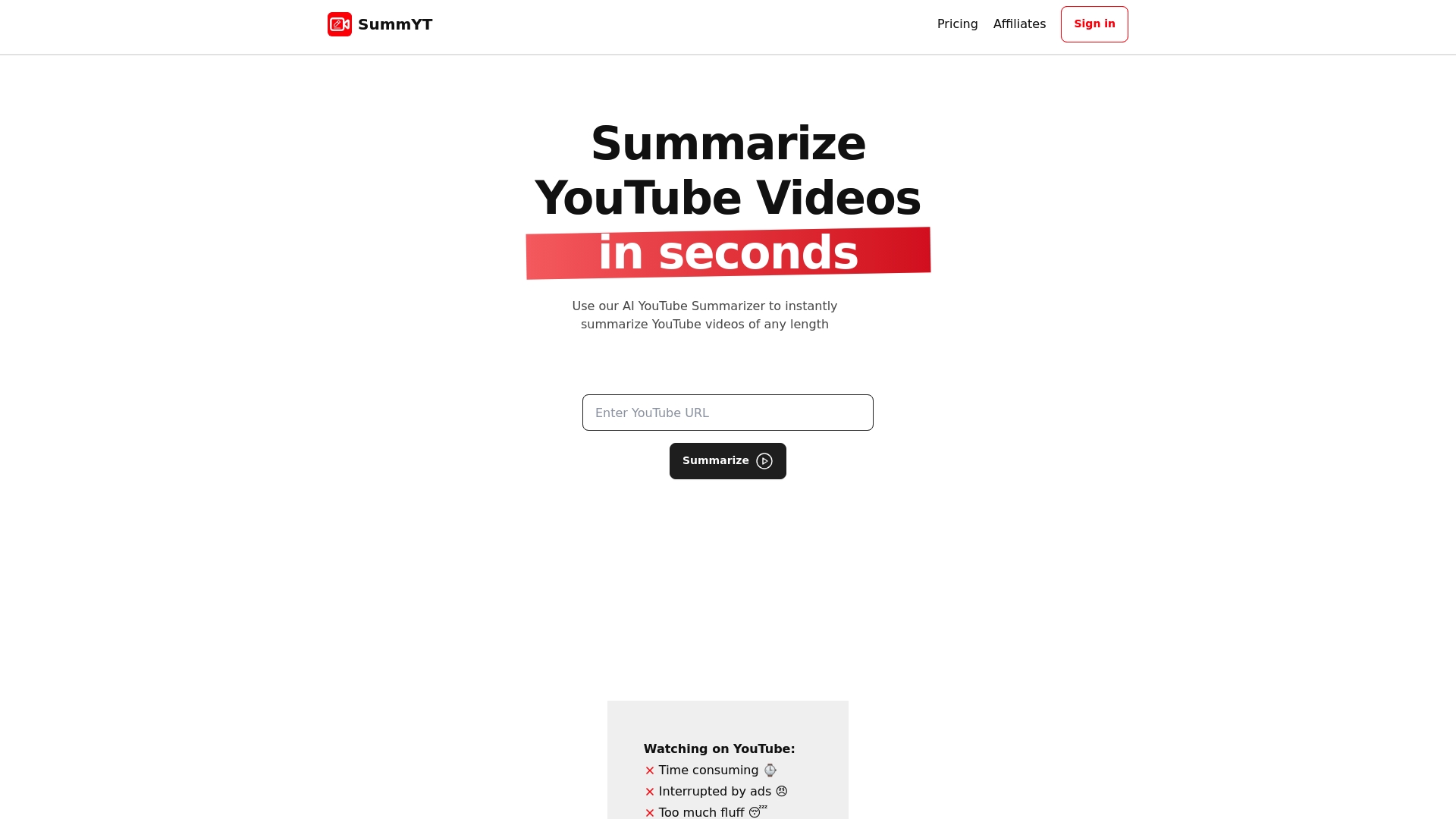
Experience firsthand how SummYT tackles the exact challenges described in the article with advanced semantic analysis and hybrid summarization methods. Whether you are a student researcher or lifelong learner SummYT helps you stay informed and efficient by removing fluff and surfacing key takeaways from any lecture tutorial or webinar in minutes. Get started now at SummYT and see how our unlimited summaries browser extensions and multilingual support can accelerate your learning journey. Don’t spend hours watching when you can master content faster Learn more and transform your video study habits today.
Frequently Asked Questions
What is content summarization?
Content summarization is the process of distilling complex information into concise, meaningful representations while preserving essential insights. It involves transforming extensive source material into a compact form that captures the fundamental message and key details.
What are the types of content summarization techniques?
The main types of content summarization techniques include extractive summarization, which selects key segments from the original content, abstractive summarization, which generates new representations of the content, and hybrid methods that combine both approaches for more comprehensive summaries.
How does content summarization benefit students and researchers?
Content summarization benefits students and researchers by providing a faster, more efficient way to extract critical insights from extensive materials. It enhances learning efficiency, improves information retention, and allows for better comprehension of complex topics through condensed representations.
What are common challenges with content summarization?
Common challenges include semantic drift, where automated systems may distort critical context, information loss, which can result in missing key details, and over-reliance on automation, potentially leading to superficial understanding. It’s crucial to verify summaries against original content for accuracy.